How to prepare your child for a doctor’s appointment
For a grown-up, a doctor’s appointment is a small item on the calendar. For a three- or four-year-old, it can be a big unknown: a new room, a stranger, instruments that look strange and questions about their body. The good news is that a little preparation goes a long way. Children cope best with what they can picture in advance.
In this article we share the simple, practical steps we like to use before a check-up or a visit for a minor illness. None of it takes long, and most of it can feel like play.
Why preparation helps
Young children often feel worried when they do not know what is going to happen next. A doctor’s visit is full of small surprises: being weighed, lying on a paper-covered bed, a cold stethoscope, someone looking in their ears. When a child has heard about these things before, they become familiar steps rather than shocks.
Preparation also gives your child words. A child who knows the word “stethoscope” and knows that the doctor uses it to listen to their heart has something to hold on to. It turns a mysterious moment into a small, understandable one.
Talk about it a few days before
There is no need to announce the appointment weeks ahead; for most young children, two or three days is plenty. Choose a calm moment, not bedtime or the car ride to the surgery.
Keep it simple and honest
Tell your child where you are going, who they will meet and why. “On Thursday we’re going to see Dr. Martin. She’s going to check that you’re growing well and that your body is healthy.” Short, clear and true.
Avoid promises you can’t keep
It is tempting to say “it won’t hurt at all” or “there won’t be any injections”. If you are not sure, don’t promise. If a vaccination is planned, you can say something like: “You might have a little pinch in your arm. It stings for a moment, then it’s finished, and I’ll be right next to you.” Children trust us more when what we said matches what happens.
Explain what the doctor might do
Walk through the likely steps, in the order they may happen:
- Saying hello and answering a few questions
- Being weighed and measured
- The doctor listening to the heart and breathing with a stethoscope
- Looking in the ears, the mouth and sometimes the eyes with a small light
- Gently pressing on the tummy
Every visit is different, so present this as “the doctor might”, not “the doctor will”.
Play doctor at home
Pretend play is one of the best ways for children to process something new. A toy doctor’s kit is lovely, but you do not need one: a kitchen funnel can be a stethoscope, a torch can check ears, and a teddy makes a very patient patient.
Let your child be the doctor first. They can listen to the teddy’s heart, look in its ears and tell it that it is doing a great job. Then swap roles and let them be the patient while you narrate gently: “Now I’m going to listen to your heart. Can you take a big breath? Well done.”
This is also a lovely moment to practise the body words they will hear. If your child loves these words, our article on how to talk to young children about their body has more ideas.
Read a story about it together
Books are a calm, safe way to meet a new situation before living it. A picture book lets your child look at the waiting room, the instruments and the doctor’s face as many times as they like, at their own pace, on your lap.
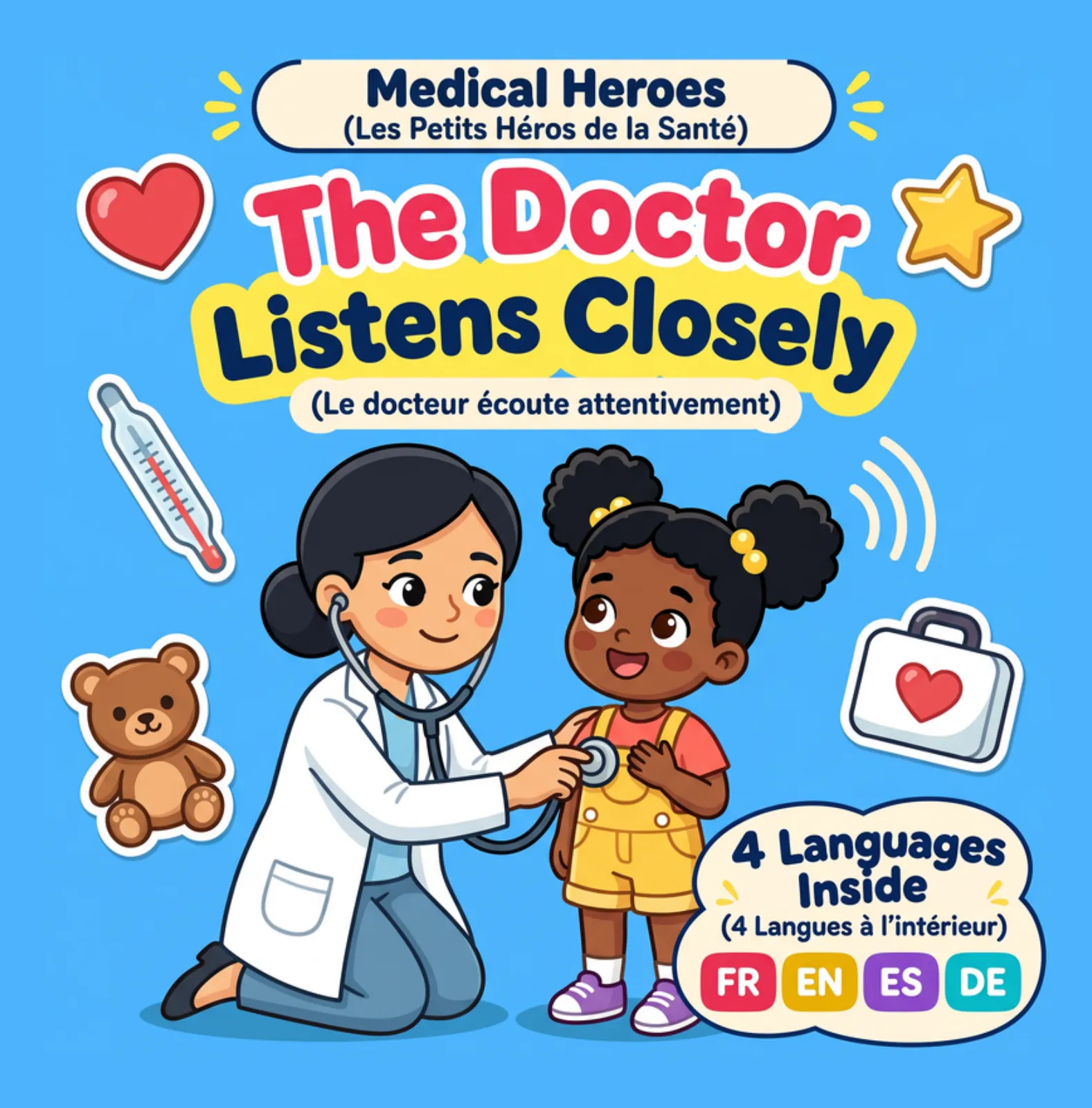
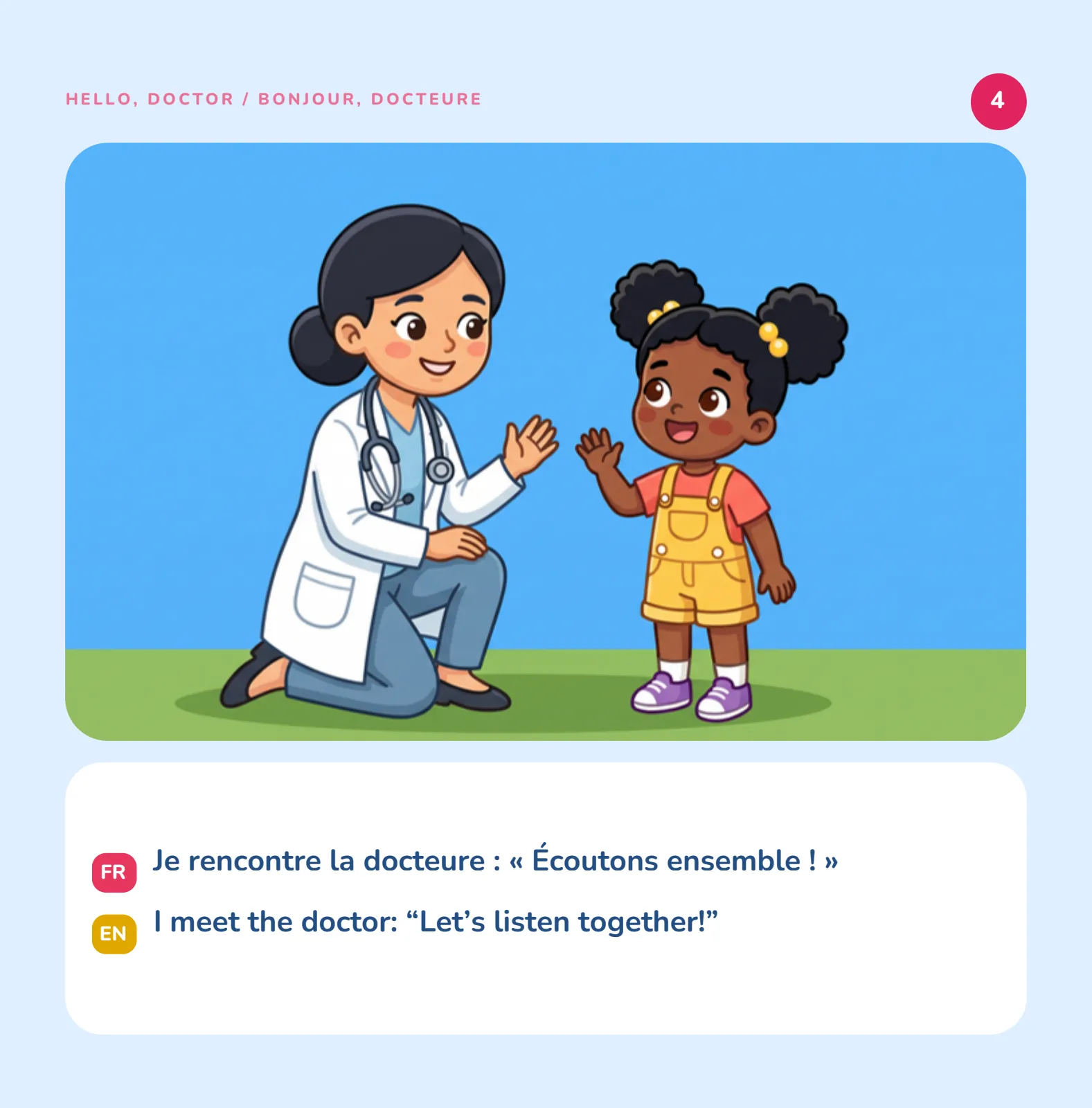
This is exactly why we created the Medical Heroes series. In The Doctor Listens Closely, children discover how a doctor listens, checks and helps children feel better, with colouring pages at the end so they can make the story their own. Other titles introduce more of the people they may meet: Nurses Make Care Better, Pharmacists Prepare Helpful Medicines and, before the first check-up with a dentist, Dentists Protect Every Smile.
Each book is a 58-page square picture book with English, French, Spanish and German in the same book, made for ages 3–7. Reading one a few evenings before the visit, then once more on the day, gives your child familiar pictures to recognise in the real room.
Plan the day itself
A little practical planning can make the appointment smoother for everyone.
Choose a good time if you can
If you have a choice, avoid times when your child is usually tired or hungry. A well-rested, fed child copes with waiting and new experiences far more easily.
Pack a small comfort bag
- A favourite cuddly toy or blanket
- A book or two for the waiting room
- A snack and a drink, if allowed
- A small notebook with any questions you want to ask
- Your child’s health record or any documents the practice asks for
Bring your own list
Write down your questions and anything you have noticed before you go. In the moment, with a child on your knee, it is easy to forget. The doctor is the right person to answer questions about your child’s health, so don’t hesitate to ask.
During the visit
Your calm is the most reassuring thing in the room. Children watch our faces closely, so a relaxed voice and a smile do a lot of work.
- Let your child sit on your lap if they prefer and the doctor agrees.
- Name what is happening: “The doctor is going to listen to your heart now, like we did with teddy.”
- Invite your child to answer simple questions themselves, if they want to. It helps them feel involved.
- If they cry or say no, that is all right. Stay close, stay calm, and let the doctor guide what happens next.
Try not to use the doctor as a threat at other times (“if you don’t eat your vegetables, the doctor will give you an injection”). We want the doctor to be someone who helps, not someone to be afraid of.
Afterwards: talk, praise, play
Once the visit is over, take a moment to talk about it. What did your child see? What was the doctor’s name? Which part was easy, which part was hard? Praise the effort rather than the result: “You were brave to let the doctor look in your ears, even though you didn’t like it.”
Many children like to replay the visit with their toys for a few days. That is a healthy way of digesting the experience, so join in if you’re invited. Colouring is another gentle way to revisit it; we explain why in why colouring helps children remember what they read.
Meeting all the healthcare heroes
Doctors are only one of the people who look after children’s health. Over the years, your child will also meet nurses, pharmacists, dentists, perhaps a physiotherapist or a paramedic. Getting to know these jobs early, in a calm and friendly way, can make each first meeting feel a little more familiar.
If you would like the whole set, Medical Heroes — all 10 books brings together doctors, nurses, pharmacists, paramedics, midwives, physiotherapists, dentists, lab scientists, psychologists and dietitians in one download. You will find all our picture books on the books page.
In short
Preparing your child for a doctor’s appointment does not require a script. A few honest words, a round of pretend play, a story read together and a calm presence on the day are usually enough to turn a big unknown into a manageable adventure. And every visit that goes well, even with a few tears, makes the next one a little easier.