How to organize a kids’ escape room at home
Escape rooms are not just for grown-ups. Children love a mystery, especially one where they are the heroes, and a home escape room turns an ordinary afternoon into an adventure. It works for a birthday, a rainy weekend, a sleepover or simply a special family evening.
The idea is simple: children solve a series of puzzles to unlock a final “treasure” or rescue someone, all within a story. You don’t need padlocks, smoke machines or a big budget. Here is how we suggest organising one for children around ages 5 to 7.
Start with a story
A story is what turns a list of puzzles into an adventure. It gives the children a reason to solve each clue and a goal to reach. Keep it short enough to tell in a minute, and make the children the heroes.
A few story ideas that work well:
- A treasure chest has been locked by a mischievous pirate, and only the crew can open it.
- A friendly dragon has lost its egg, and the explorers must follow the clues to find it.
- The lights of a magical lighthouse have gone out, and the team must switch them back on.
- The birthday cake has been hidden by a sneaky (and very polite) monster.
Tell the story with a little drama, maybe with a letter “found” on the doormat or a voice message from a character. That first moment sets the mood for everything that follows.
Choose puzzles that match the age
The secret of a good kids’ escape room is that the puzzles feel challenging but are actually achievable. A child who solves a puzzle feels brilliant; a child who is stuck for ten minutes loses interest.
For younger children (around 4 to 5)
- Picture puzzles: cut a drawing into four or six pieces and hide them around the room.
- Colour matching: a clue says “look under something red”.
- Counting: “How many chairs are in the kitchen? That’s the number of steps to take.”
- Simple hidden objects to find in a picture.
For early readers (around 6 to 7)
- Short riddles with one clear answer.
- Simple codes, where each symbol stands for a letter.
- Mazes on paper that reveal the next hiding place.
- Word locks: the answers to three questions spell a secret word.
Mix different types of puzzle so that everyone in the group has a moment to shine: the child who loves drawing, the one who loves counting, the one who notices tiny details.
Plan the order of the clues
Most home escape rooms work best as a chain: each puzzle leads to the next one, and the last one unlocks the treasure. Before the children arrive, write your chain down on a piece of paper.
- The story letter reveals the first clue.
- Clue 1 leads to a hiding place with puzzle 2.
- Puzzle 2 gives a number or a word that leads to puzzle 3.
- Continue for four to eight puzzles.
- The final answer opens the treasure box.
Then walk through the chain yourself once, to check that every clue leads where it should. It is easy to forget that a clue is hidden in a drawer someone has since emptied.
Make the “lock” and the treasure
You don’t need a real padlock. A shoebox wrapped in paper and taped shut can become a treasure chest, with a sign saying “Only the magic word opens this box.” When the children say the right word, you open it with a flourish.
Inside, put something small that matches the story: stickers, a certificate, a homemade medal, a few treats if appropriate, or simply the hidden birthday cake. The surprise matters much more than the value.
Hide clues safely
Choose hiding places at child height, in rooms you are happy for children to explore. Under cushions, inside a book, taped under a chair, behind a plant pot. Avoid anywhere high, fragile or off-limits, and close the doors of rooms that are not part of the game.
Prepare a hint system
Even the best puzzles can cause a child to get stuck. A hint system keeps the game flowing without simply giving away the answer. We like a three-step approach:
- Hint 1: a gentle nudge (“Have you looked at the colours?”).
- Hint 2: a stronger clue (“The red things in this room are important.”).
- Hint 3: almost the answer (“Look under the red cushion.”).
Decide in advance whether hints are free or cost something fun, like a silly dance. That way, asking for help feels like part of the game rather than a failure.
Timing and group size
For children aged 5 to 7, aim for about 20 to 45 minutes of play. A visible timer can add excitement for older children, but it is optional; for many little ones, a calm pace is more enjoyable. If you have a large group, split it into small teams of two or three and give each team their own copy of the puzzles.
Plan a little time for the story at the start and for celebrating at the end. The final moment, when the box opens, deserves a proper drum roll.
A printable escape room, ready to go
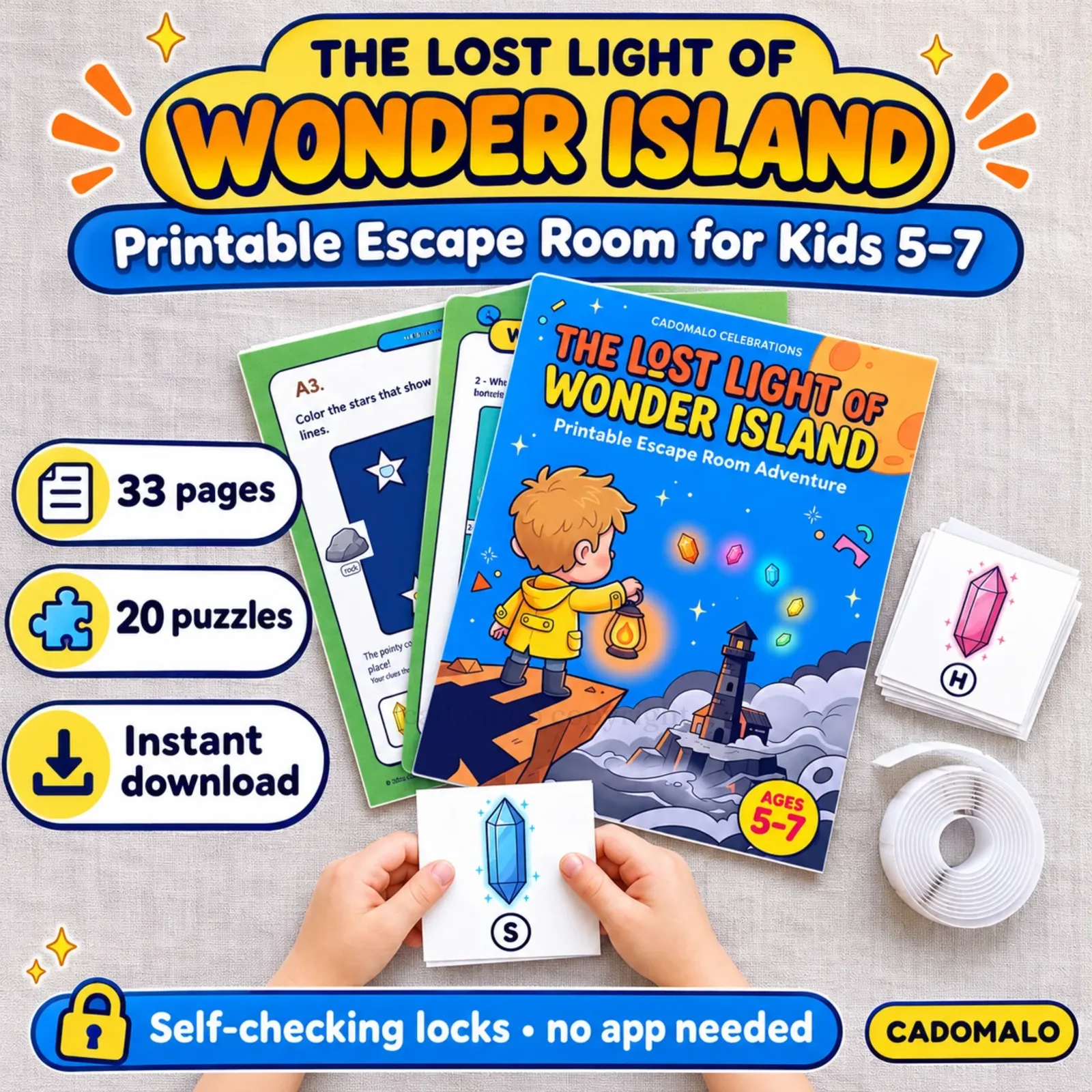
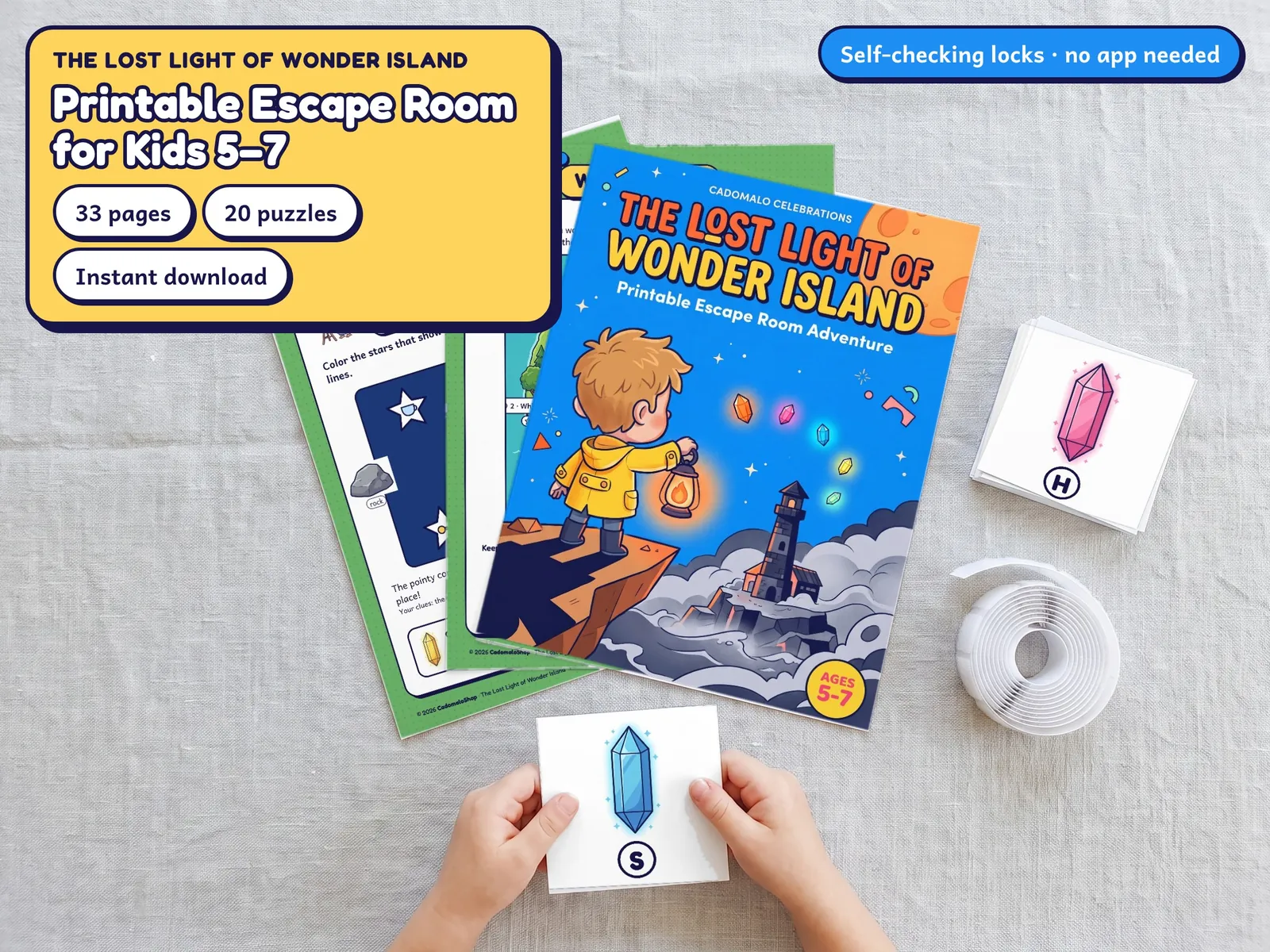
Designing puzzles from scratch is fun, but it takes time. If you would rather print and play, we created the Wonder Island Escape Room for exactly this. The lighthouse of Wonder Island has gone dark, and your child joins Finn and his squirrel friend Pip to solve 20 missions in 5 magical worlds, open 5 secret locks and switch the lighthouse back on.
The locks are self-checking (the right code spells a real word), and there is a hint sheet with three-step hints and a full answer key. One world takes about 20 to 30 minutes, or you can play the whole adventure in an afternoon. It works for one child, siblings or a small group, and it is made for ages 5 to 7.
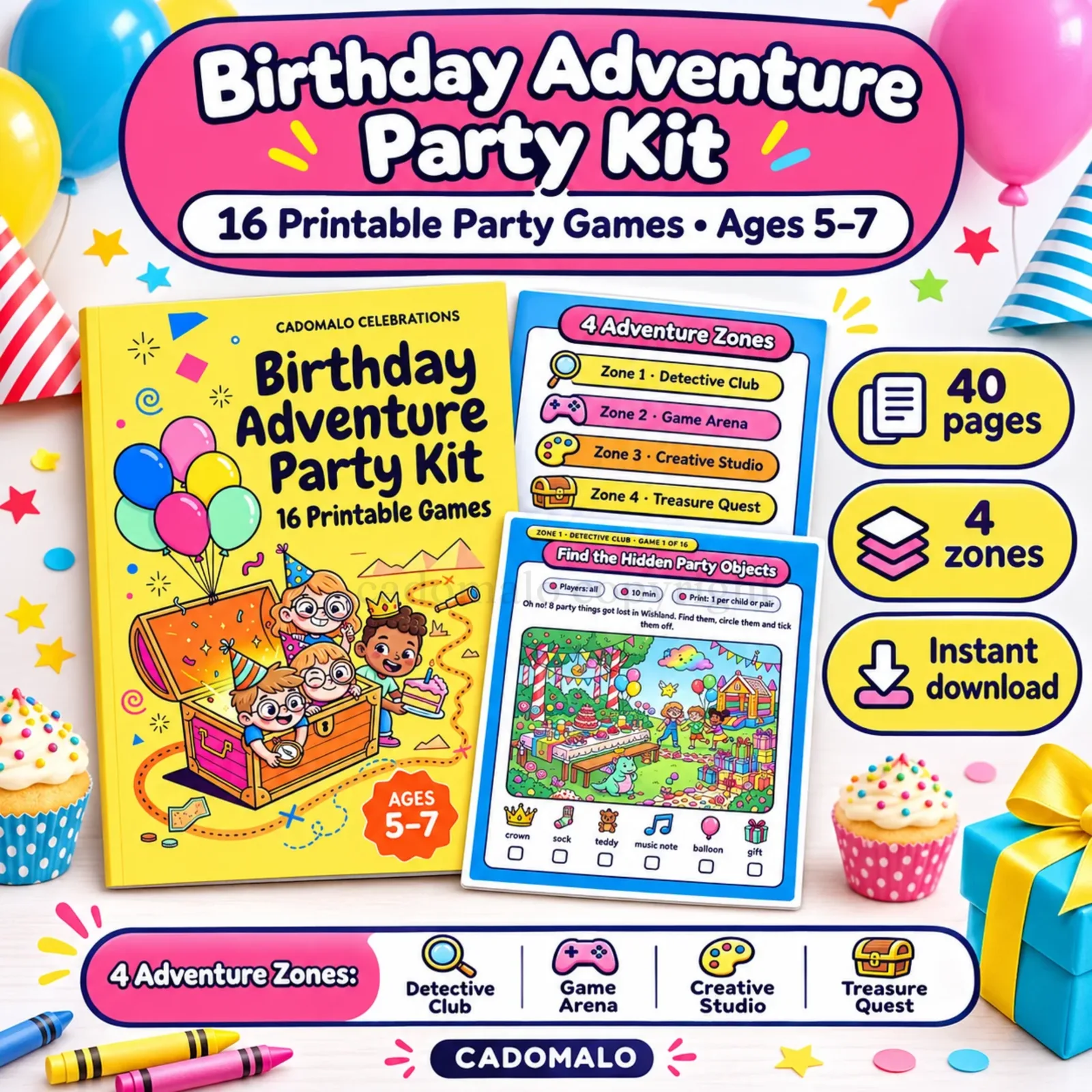
Planning a birthday rather than a family afternoon? The Birthday Adventure Party Kit uses the same treasure-quest idea for a whole party, with 16 games for 4 to 10 children. You will find more party ideas in our list of indoor birthday party games and in our party kits.
Why escape rooms are great for learning
Beyond the fun, a home escape room quietly practises many skills: reading clues, counting, spotting patterns, remembering, working as a team and not giving up when something is hard. Children rarely notice they are learning, because they are too busy saving the lighthouse. That is exactly the kind of learning we love, and you can read more about it in our article on why colouring helps children remember. Browse all our printable adventures in the escape rooms section.
In short
A good kids’ escape room needs a simple story, a chain of age-right puzzles, safe hiding places, a hint system and a treasure worth unlocking. Test it once, keep it short and let the children be the heroes. The puzzles will be forgotten, but the feeling of cracking the final code usually is not.