How to create a morning routine for kids
If your mornings sound like a loop of “shoes on”, “teeth, please”, “we’re going to be late”, you are in very good company. Young children are not built for rushing. They live in the present moment, they get distracted by a sock, and they do not yet have the inner clock that tells adults what comes next.
A morning routine does not change your child’s personality, but it can change the shape of the morning. When the steps are always the same, and your child can see them, they need fewer reminders and you need less energy. Here is how we suggest building one, step by step.
Why routines help young children
Routines give children something they deeply need: predictability. When a child knows that breakfast comes after getting dressed and that teeth come after breakfast, they do not need to negotiate every step. The order is simply “how we do things”.
A good routine also gives children a sense of competence. Every step they complete by themselves is a small win. Over time, the routine stops being your list of instructions and becomes their job, something they are proud to manage.
Step 1: Decide on the steps together
Start by writing down what really has to happen every school or nursery morning. Keep it short. For most families with children aged 3 to 7, it looks something like this:
- Wake up and use the toilet
- Get dressed
- Eat breakfast
- Brush teeth and wash face
- Brush hair
- Shoes and coat on, bag ready
Then sit down with your child and talk it through. Ask them what they think comes first. Children cooperate far more with a plan they helped to make, even if you guided most of the decisions.
Keep it to a handful of steps
Five to seven steps is usually plenty for a young child. If your list is longer, combine steps (“wash face and brush teeth”) or move some of them to the evening, like choosing clothes or packing the bag.
Step 2: Make it visual
This is the part that makes the biggest difference. Most young children cannot read a written list, and even early readers respond much better to pictures. A visual routine lets your child check “what’s next?” without asking you.
You can draw simple pictures on cards, take photos of your child doing each step, or use ready-made picture cards. Line them up somewhere your child can reach: on the fridge, on their bedroom door, or on a board at their eye level.
Let your child move the cards
A routine they can touch works better than one they only look at. A simple system is to have a “to do” column and a “done” column. When a step is finished, your child moves the card across. It is satisfying, it is visible, and it lets you say “What does your board say?” instead of repeating the instruction yourself.
Step 3: Get the timing right
Rushing is the enemy of a good routine. Most routines fall apart not because the steps are wrong, but because there is not enough time to do them calmly.
- Count how long each step really takes your child, not how long it would take you.
- Add a buffer of ten to fifteen minutes for the unexpected.
- Work backwards from the time you need to leave to find your wake-up time.
- Prepare what you can the night before: clothes laid out, bag packed, breakfast things on the table.
Some families find it helps to keep screens off until the routine is done. That is your choice to make, but if screens tend to derail your mornings, it is worth trying for a week.
Step 4: Practise when it’s calm
Introduce the new routine on a relaxed day, like a weekend morning, rather than on a busy Monday. Walk through each card together and turn it into a game: can teddy follow the routine? Can your child show you how it works?
Expect the first week to be a learning period. Stay nearby, point at the cards, and celebrate the steps that go well. You are teaching a new skill, and like any skill, it takes repetition.
Step 5: Encourage, don’t nag
Once the routine is in place, try to shift your role from instructor to coach. Instead of “Put your shoes on!”, try:
- “What’s the next card?”
- “Show me what’s left on your board.”
- “You already did three steps. Two more to go!”
A weekly star chart can add a little extra motivation for children who love collecting things. Keep rewards simple: a star, a sticker, the honour of choosing Saturday’s breakfast. The aim is for the routine itself to become the habit, not for every step to earn a prize.
A ready-made visual routine
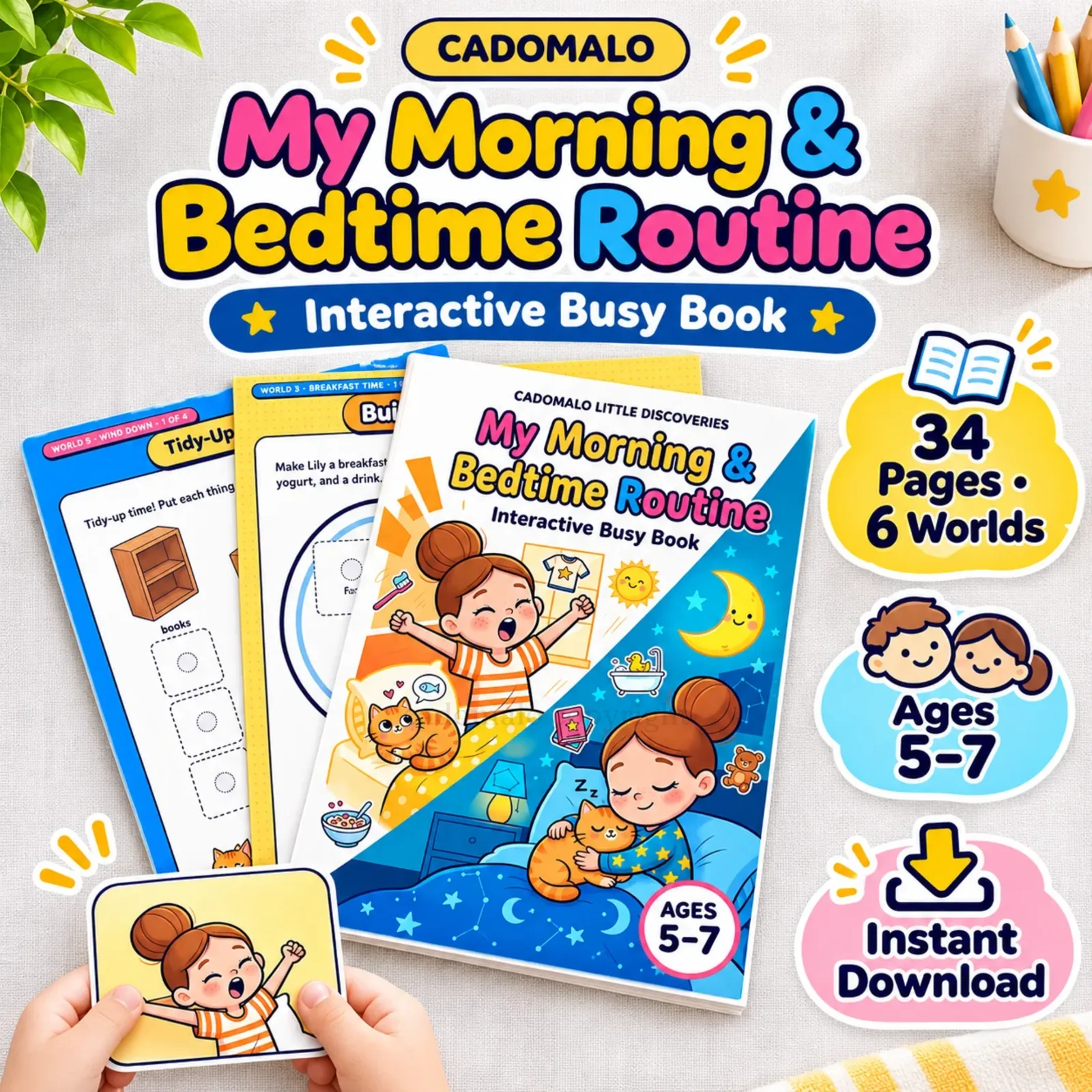
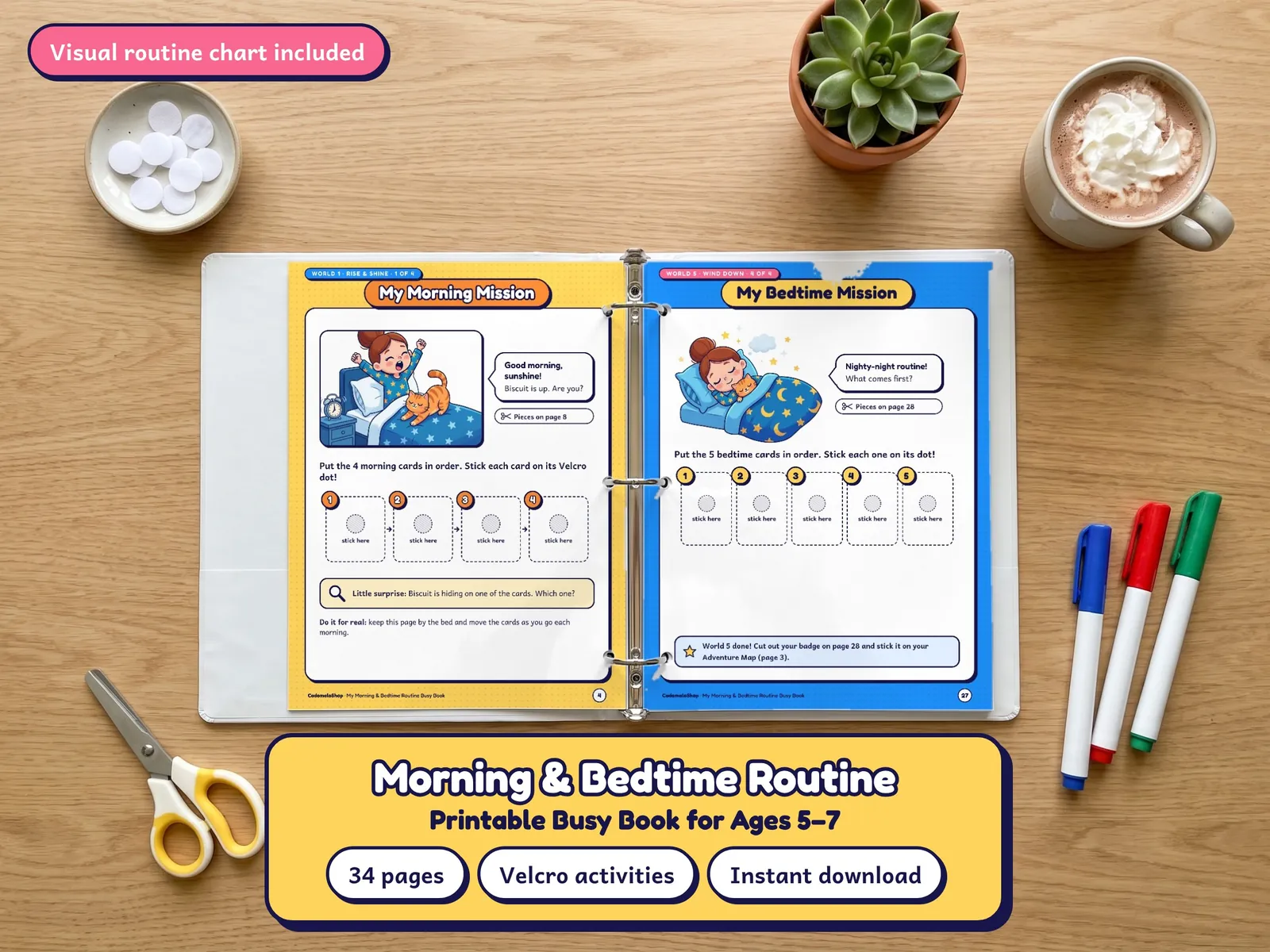
If you would like the visual routine without making all the cards yourself, this is what we created the Morning & Bedtime Routine Busy Book for. Your child travels through six routine worlds, from Rise & Shine to Sweet Dreams, with Lily and her cheeky cat Biscuit. There are 24 activities, more than 80 cut-out pieces such as routine cards, clothes and foods, plus a weekly star chart and a Routine Superstar certificate.
It is made for ages 5 to 7 and printed at home. You will need a printer, card stock, a laminator or sheet protectors and some Velcro dots, which are not included. Once laminated, the pieces can be used every day.
Looking for something screen-free for tonight as well? Our free Mini Discovery Kit is a short science mission about the 5 senses that you can print in minutes.
When the morning still goes wrong
Even the best routine will have bad days. Children get ill, sleep badly, wake up grumpy or simply do not feel like it. That is normal, and it does not mean the routine has failed.
- Stay calm and keep the order. Even on a hard morning, returning to the board gives everyone something steady.
- Skip the extras, not the structure. If you are late, drop the non-essential step but keep the sequence.
- Talk about it later. In the evening, ask what made the morning tricky and whether a card needs to change.
- Review the routine every few months. As your child grows, they can take on more steps by themselves.
Don’t forget the evening
Mornings often start the night before. A short, predictable evening routine (bath, pyjamas, teeth, story, lights out) helps children settle and wake more easily. Choosing tomorrow’s clothes and packing the bag in the evening also takes pressure off the morning. A bedtime story is a lovely last step; our article on raising multilingual kids even suggests using bedtime for a second language.
You will find our routine and activity books in the busy books section.
In short
A good morning routine is short, visual, the same every day and built with your child. Give it enough time, practise it when things are calm and let your child move from following instructions to running their own morning. It will not make every morning perfect, but it can make most of them calmer.